/ Blog / A Primer on Deliverability: Donald Trump, Spam and Your Email Reputation, Part 2
In my last post from yesterday you learned the difference between delivered rate and deliverability. We also dispelled a few common myths about what does - and does not - guarantee that your email will reach the inbox.
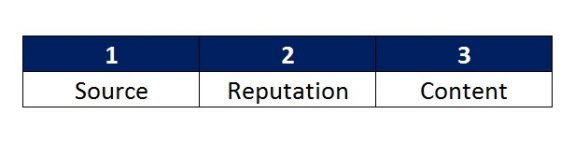
Today I want to start to focus on the three key elements that ISPs look at to determine whether or not to inbox a message; they are:
The best way to keep your message from being falsely identified as spam is to understand what the ISPs are looking at and be sure that your missive won't raise any red flags. We're going to cover the basics that you need to know - and I've included links to more detailed information for some key areas
1. Source
The source of the email refers to the domain as well as the IP address that you are sending from. The ISP wants to confirm or authenticate that the message is coming from a legitimate sender, not a spammer. Many spammers will use multiple IP addresses and domains and, when one gets blacklisted, quickly shift to another one. As a legitimate email marketer there are 2 simple things you can do to show the ISPs that your email isn't spam:
When a new or previously dormant IP address or domain shows up on an ISP's radar sending a large volume of email right away it raises a red flag. To an ISP, it looks like a spammer who has just shifted IP addresses or domains after being blacklisted.
To avoid being mistaken for a black hat sender you should begin with a low send quantity and gradually work up to sending your full list. This is one of the reasons that the Trump campaign was filtered as spam; they were using a new domain to send email for the first time and they neglected to warm it up.
Put authentication in place
There are a number of different authentication methods used by the ISPs - the most common are Sender Policy Framework (SPF), DomainKeys Identified Mail (DKIM) and Domain-based Message Authentication, Reporting & Conformance (DMARC). They all work in slightly different ways but in all cases they allow you to provide information in your DNS record that the ISPs can check against the headers of any email they receive from you (or a spammer pretending to be you) to confirm that the message is legitimate. If it all matches, great! If not, there's a good likelihood the email will be filtered as spam.
If you're using a SAAS send solution (often called an email service provider (ESP) or a marketing automation platform (MAP)) they should have worked with you on authentication during implementation. If you are sending from software hosted on your own servers, you'll need to have your IT team handle authentication. It's not difficult (the links above should provide all the information you need) nor is it time consuming to put authentication in place. Which is why it's so odd that more email marketers don't do it
2. Reputation
Your email reputation is probably what has the greatest influence on your deliverability; every IP address as well as every domain you send from will have its own email reputation.
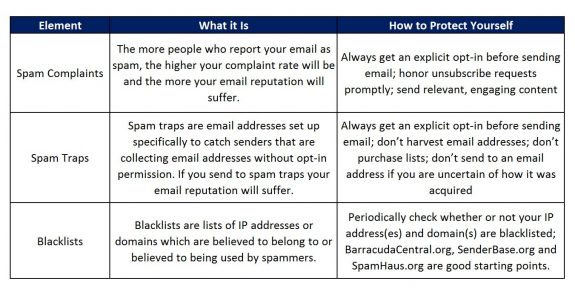
Your email reputation is determined by an algorithm created by the ISPs and other anti-spam organizations that act as industry gate-keepers. Much as Google does with search algorithms, they are constantly tweaking and updating the formula to try to improve it. That said, there are some things that always factor into your reputation score in one way or another:
3. Content
While the content of your email does matter, it doesn't matter nearly as much as the source of the message and your email reputation. This is where a lot of inexperienced email marketers fall down; they assume that if the email gets a 'not likely to be spam' rating from a content filter that it won't be filtered as spam.
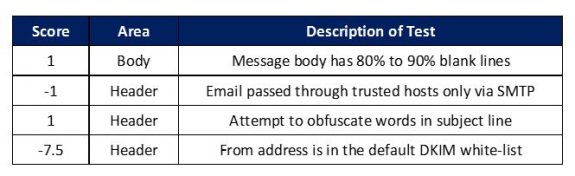
Content filters assign points based on things that are likely and unlikely to appear in an email that is spam. SpamAssassin is the most common content filter; here are some sample point values:
The higher your SpamAssassin score, the more likely it is that the email is spam and that you will not reach the inbox. So the positive scores above are not good; the negative scores are good. See how DKIM authentication earns a -7.5 score? DKIM authentication can help ensure that your message gets through the content filter, even if the email would be filtered as spam without it.
I hope you enjoyed this 2-part primer on deliverability. If your email doesn't reach the inbox it doesn't really matter what strategy or tactics you employ; it won't be as successful as it could be. If you're looking for help with deliverability or if you want to make your email marketing initiatives more effective and more profitable but aren't sure how to start, feel free to contact me at JJennings@CohereOne.com and we'll see if we can help.