/ Blog / 3 Tips for Turning Free Subscribers into Paying Buyers
What percentage of people on your email list are past buyers?
How many of your email subscribers have purchased from you more than once?
Know the percentages off the top of your head? Well done! No idea? No worries; that's not unusual. No matter what your answer, read on for industry benchmarks and advice on how to turn more of your email subscribers into ongoing buyers.
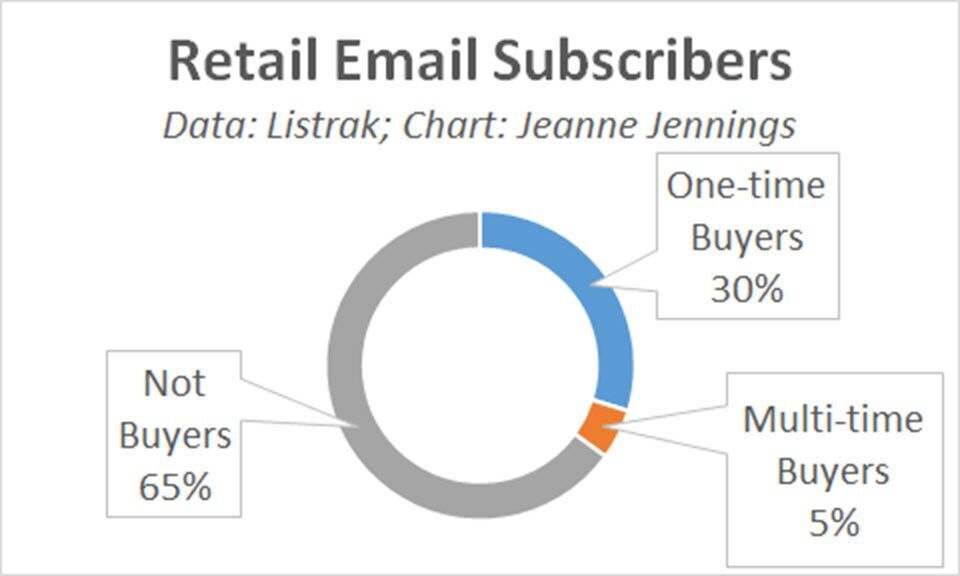
According to a study done by Listrak, only 35% of the average retailer's email list is made up of buyers - and the vast majority of these are one-time buyers; only 5% of the total list have made multiple purchases. That means that the majority of your list hasn't bought from you. Ever.
Many retailers are focused on growing their email lists and that's not a bad thing. But just having a large email list does not guarantee that you are optimizing revenue. And in the end, it's revenue that keeps the lights on for your business - not the number of people on your email list.
Here are three tips for generating more revenue from your email subscribers.
Don't Overlook the Potential in Your Welcome Message
When people join your email list it's the beginning of a more serious relationship, a honeymoon period - which makes your welcome message a critical part of 'setting the tone.' Done properly it's also a revenue opportunity.
What's the conversion rate on your initial welcome message? How much revenue does it generate, on average, for each email that you send?
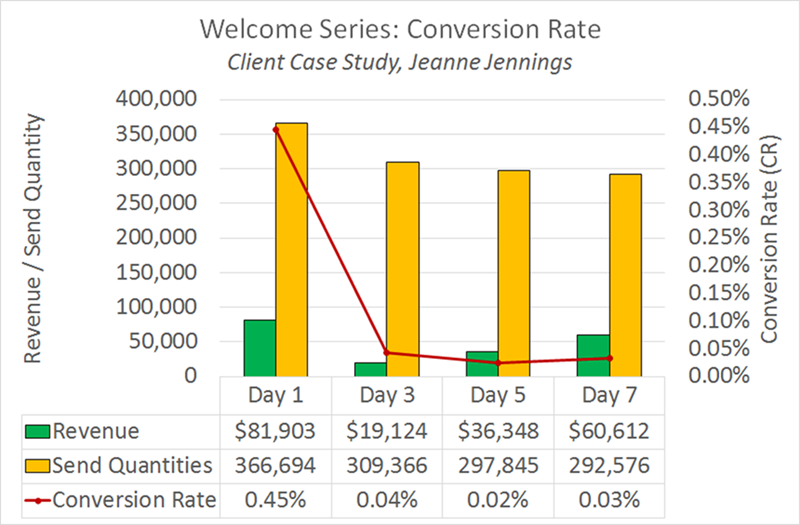
I worked with a business-to-consumer specialty online retailer with a 4-effort welcome series. All efforts included a call-to-action to buy, but only the final effort offered a discount.
The very first effort had the highest conversion rate (0.45%) of the series - without any type of special offer. How does that compare to the conversion rate on your initial welcome message?
The conversion rate is more than ten times the conversion rate on any of the other efforts. These people were close to buying when they signed up for email - and the message was crafted well enough to get a large percentage of them to convert right away - without a discount!
Side note: the revenue-per-non-bounce-email (RPE) metric on that first message: more than $0.22. How does that compare to the RPE on your first welcome message?
Use What You Know About Your Subscribers
Data, customization, personalization. These are buzz words in the digital marketing industry today - but how well are you leveraging the opportunity here?
Many retailers I speak to are missing out - they think they don't have the data to customize or personalize messages.
Most are wrong.
Something as basic as segmentation based on past purchase behavior (never, once, more than once, per the Listrak study) can be effective.
Getting a bit more sophisticated you can look at what links in your email messages each individual is clicking on to give you a good idea of what the people on your email list are interested in.
Going a step further, individual browse behavior and cart abandonment information (which are easier to track than you probably think) will give you a lot of data to use to target messages to your prospects and customers.
According to data released by Experian, personalized and customized email campaigns have double the response rates of email campaigns which aren't personalized.
What would your bottom line look like with double the response rate on your email messages?
If You Think You're Losing Them, Do Something Before It's Too Late!
It happens. People opt-in to receive email from your brand and then... they just stop engaging. They don't open, they no longer click, there are no more purchases (there may not have ever been any purchases).
When does this start to happen en masse with your list?
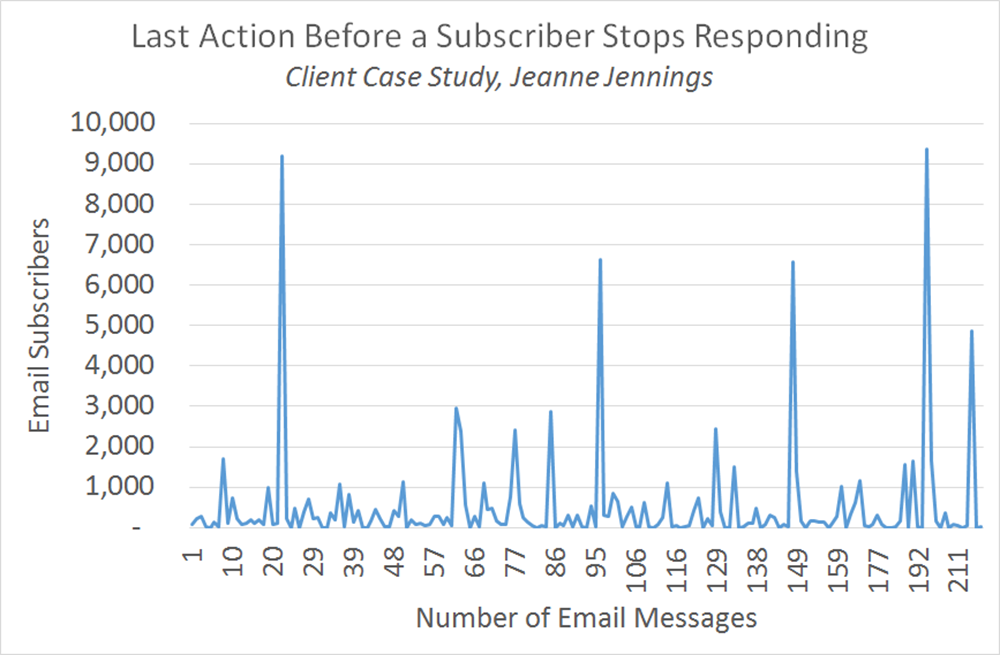
In an analysis we did for a client (below), we learned that the first large spike for their list happened after the first 22 email messages the person was sent. A small spike occurred after 8 email messages.
Based on this analysis, we extended the welcome series past the initial 5 efforts and increased customization in an effort to keep readers opening, clicking and converting on the messages.
We also moved up the timeline on the reactivation program, geared toward bringing dormant email subscribers (no opens, no clicks, no conversions) back to life. Prior to this the reactivation campaign was sent when someone was dormant for six months. After this analysis we became more aggressive and started reactivation when a reader didn't open or click on 3 consecutive messages.
When you put a campaign in place it's important to do the analysis on your list to determine the best timing - and to customize the content to make it more relevant to the recipient. These are some of the first things I look at for clients and more often than not we find that small tweaks generate big boosts in revenue.
The Bottom Line
Too many retailers are half-heartedly implementing digital tactics to improve performance - and some haven't implemented them at all!
The devil is in the details - just because you have a welcome series in place doesn't mean it's optimized to generate as much revenue as possible.
It's not difficult - but it helps to have someone with experience guiding you. If you're looking to boost the bottom-line performance of your email marketing program, let's chat (JJennings@CohereOne.com). We'd love to help.